_edited.png)
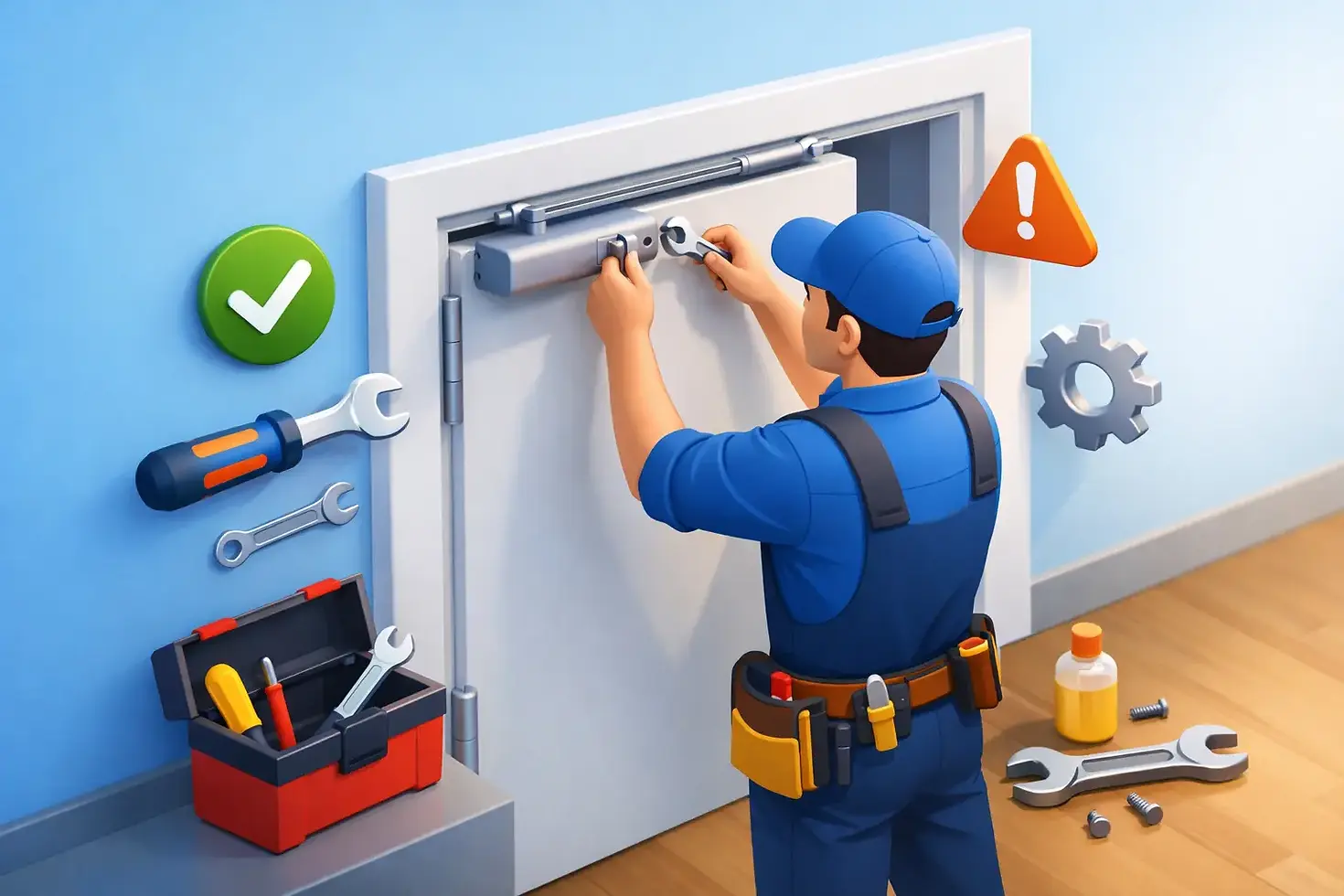
When You Need a Door Closer Adjustment Service

A commercial door that slams, drifts open, or will not latch is more than an everyday annoyance. It can interrupt customer traffic, create a security gap, damage the frame, and make an entrance difficult to use. A professional door closer adjustment service restores controlled door movement without leaving your business to guess at screws, springs, or hardware settings.
For businesses, rental properties, offices, restaurants, medical facilities, and retail spaces across the Florida Panhandle, the goal is simple: the door should open with reasonable effort, close at a steady pace, and latch securely every time. When it does not, prompt on-site service can prevent a small hardware issue from becoming a bigger repair.
What a Door Closer Is Supposed to Do
A door closer uses a spring and hydraulic fluid to bring a door back to its closed position after someone opens it. Most commercial closers are mounted at the top of the door or frame, although concealed and floor-mounted styles are also common. The closer controls the door through different parts of its swing rather than simply pulling it shut as fast as possible.
A properly adjusted closer should allow a visitor to enter without fighting a heavy door. It should then guide the door closed at a measured speed and apply enough final force to engage the latch. That final movement matters. A door can look closed while the latch is not fully seated, leaving the opening unsecured.
Door closer performance depends on the door weight, the hinges, weatherstripping, air pressure, lock hardware, and the closer itself. This is why a setting that works well for one entry may not work for another. A storefront glass door, a solid exterior metal door, and an interior office door each need a different approach.
Signs You Need a Door Closer Adjustment Service
The clearest sign is a door that slams hard enough to rattle the frame. Besides being loud, slamming can loosen hardware, damage finishes, and create a pinch hazard for customers and employees. On the other end of the problem, a door that closes too slowly may remain open long enough to compromise climate control, security, or privacy.
A door that stops just short of latching is another common concern. The closer may lack enough closing force, but the cause could also be a misaligned strike plate, a binding hinge, worn weatherstripping, or a lock issue. Turning a closer adjustment screw without checking the rest of the opening may mask the real problem.
Schedule service when you notice any of these conditions:
The door slams, bounces off the frame, or closes unpredictably.
The latch does not catch unless someone pulls or pushes the door.
The door is difficult to open or feels much heavier than normal.
Hydraulic fluid is visible on the closer body or arm.
The closer arm is loose, bent, rubbing, or disconnected.
The door drags, scrapes, binds, or no longer lines up with the frame.
Fluid leakage usually points to a failing closer body, not a simple adjustment issue. In that case, replacement is often the practical fix. Continuing to force a leaking closer can lead to more damage at the door, arm, or frame.
Why Commercial Door Adjustments Need a Careful Approach
Many door closers have small adjustment valves for sweep speed, latch speed, and backcheck. Sweep speed controls most of the closing swing. Latch speed controls the final few inches before the door reaches the frame. Backcheck adds resistance when someone opens the door quickly, helping protect the wall, stop, and hardware from a hard impact.
Those settings interact with each other. If latch speed is set too fast, the door may snap shut. If it is set too slow, the latch may never engage. If the spring power is too high, people may struggle to open the door. If it is too low, exterior conditions or a tight latch can keep the door from closing securely.
Small adjustments can make a major difference. Over-adjusting a valve can cause leakage or failure, and not every closer has the same configuration. Some models also have delayed action, hold-open functions, or special requirements for accessibility and fire-rated openings.
That is why a door closer adjustment service should include an inspection of the complete opening. A technician should look at the hinges, pivot points, closer arm, mounting screws, latch, strike, weather seals, door alignment, and frame condition before deciding whether adjustment is enough.
Fire Doors Require Extra Attention
If the door is part of a fire-rated assembly, it must close and latch on its own. Wedges, improvised hold-open methods, and damaged closers can interfere with that function. A fire door may have special hardware requirements, and adjustments should preserve its ability to close reliably when needed.
Do not assume a door is safe because it closes most of the way. A door that fails to latch consistently needs attention. Property managers and business owners should treat that as a maintenance priority, especially in corridors, exits, storage areas, and doors separating occupied spaces from back-of-house areas.
Florida Panhandle Conditions Can Affect Door Closers
Coastal humidity, blowing rain, salt air, temperature changes, and heavy foot traffic can all affect commercial door hardware. Corrosion can weaken fasteners and arms. Wind pressure can make an exterior door behave differently from one day to the next. Swollen weatherstripping, worn hinges, or debris around the threshold can also change how a door closes.
A closer that was adjusted months ago may need attention after a storm season, a tenant change, new flooring, replacement weather seals, or a change in door usage. For example, a restaurant entry that sees steady traffic may need a different setup than a secured office entrance used only by staff.
Regular checks are especially useful for businesses near Destin, Fort Walton Beach, Niceville, Miramar Beach, Santa Rosa Beach, Crestview, and Panama City Beach, where exterior openings face heat, moisture, wind, and busy seasonal traffic. Maintenance is usually less disruptive and less expensive than waiting for a door closer to fail during business hours.
What Professional Service Should Include
A proper service visit starts by identifying what the door is doing and when the issue occurs. Does it fail only in high wind? Does it latch when the deadbolt is retracted but not when the latch bolt is engaged? Does it drag only after rain? These details help separate a closer setting issue from an alignment or hardware problem.
The technician can then inspect the door and frame, tighten loose mounting hardware, verify the arm position, check hinge condition, and test the latch and strike alignment. If the closer is serviceable, the closing cycle can be adjusted in controlled increments and tested repeatedly. The objective is not simply to make the door move. It is to make the entire opening work correctly.
When replacement is needed, the new closer should match the application. Door size, weight, location, traffic level, mounting style, and required functions all matter. Installing a closer that is too weak, too powerful, or incompatible with the door can create another service call quickly.
Xpress Locksmith provides mobile commercial door closer support throughout the Florida Panhandle, bringing help to your location so your staff does not have to remove hardware, transport a door, or wait for a storefront appointment.
When to Call Instead of Trying a DIY Fix
A minor adjustment may sound straightforward, but commercial door closers store spring tension and rely on precise hydraulic controls. If you are not certain which valve controls which action, it is easy to make the problem worse. Never remove a closer body, arm, or spring-loaded component without the right tools and experience.
Call for service promptly if the door is a fire door, serves as an emergency exit, has a card reader or access control lock, leaks fluid, has a bent arm, or will not latch. The same applies if the door is scraping the floor, pulling away from the frame, or showing loose screws in hollow metal or aluminum material. Those symptoms often involve more than a simple speed adjustment.
For non-urgent concerns, arrange service before the issue disrupts customers or tenants. For a door that will not secure, will not close, or creates a safety concern, faster action is the right move. A dependable entrance protects the people inside while keeping daily business moving.
A door closer should not demand attention from your staff every time someone walks through it. If yours is slamming, sticking, or failing to latch, get it checked while the repair is still straightforward and your entrance can return to working the way it should.


Comments